
Published on: 21 July 2026
Search is changing faster than ever. Today, people don’t just search on Google—they ask questions directly to AI-powered platforms like ChatGPT, Google AI Overviews, Gemini, and Perplexity. Instead of displaying a long list of websites, these tools summarize information and recommend the most trustworthy sources.
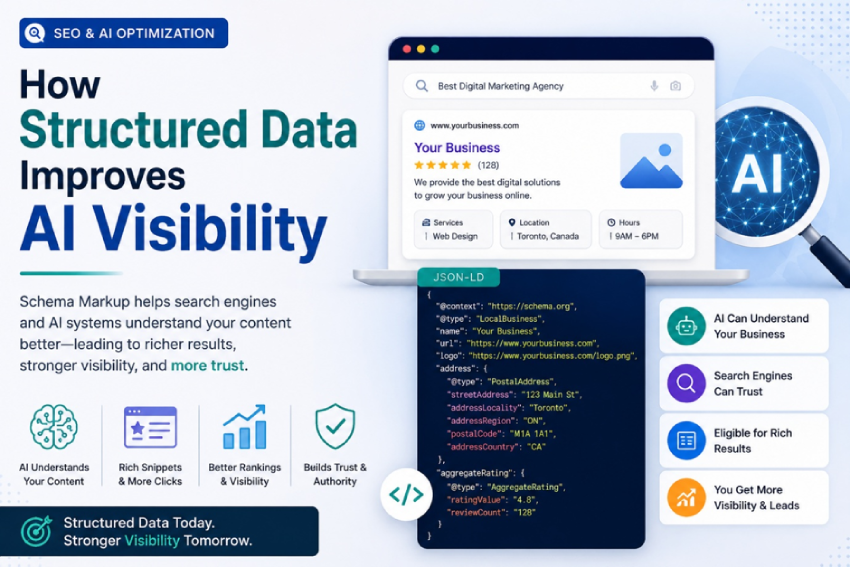
If your website isn’t structured in a way AI can easily understand, it has fewer opportunities to appear in these responses.
One of the most effective ways to improve your chances is by implementing structured data, also known as schema markup. It gives search engines and AI systems additional context about your website, making your content easier to interpret, categorize, and display.
In this guide, we’ll explain how structured data improves AI visibility, why JSON-LD schema has become the preferred implementation method, and how Future Workz builds websites that are ready for the future of AI search.
What Is Structured Data?
Structured data is standardized code added to your website that helps search engines understand exactly what your content represents.
Rather than asking Google or AI systems to guess whether a page is about a service, product, business, article, FAQ, or event, schema markup explicitly tells them.
For example, structured data can identify:
- Business information
- Services you provide
- Products
- Blog articles
- Customer reviews
- FAQs
- Contact details
- Business locations
This extra context helps search engines organize information more accurately and increases your chances of appearing in enhanced search features.
Why AI Search Relies on Structured Data
AI-powered search engines don’t simply scan keywords.
They evaluate meaning, relationships between entities, website authority, and structured information before generating responses.
Schema markup provides AI with organized information that is easier to process than plain webpage text.
Instead of interpreting every paragraph manually, AI systems can quickly recognize:
- What your business offers
- Where you operate
- Who your audience is
- Which services belong together
- Important business details
- Frequently asked questions
The clearer your website communicates this information, the easier it becomes for AI systems to reference your content confidently.
How Schema Markup Improves AI Visibility
1. Helps AI Understand Your Website
Without structured data, AI has to infer what every page is about.
Schema markup removes uncertainty by clearly identifying page types, services, organizations, products, and important information.
This improves AI visibility because your content becomes easier to interpret and categorize.
2. Improves Rich Snippets
Rich snippets display additional information directly within search results, including:
- Reviews
- FAQs
- Ratings
- Business details
- Products
- Services
Although rich snippets are a Google feature, properly structured pages also provide cleaner signals that support AI search optimization.
3. Supports Better AI Search Optimization
Modern AI search looks beyond keywords.
It considers context, authority, relationships, and structured information.
Adding structured data for SEO helps AI systems understand your content hierarchy and identify the most relevant answers for user queries.
4. Makes Your Content Easier to Reference
AI-generated answers often summarize information from multiple trusted websites.
Pages with well-organized headings, clear content, and structured schema are significantly easier for AI systems to reference accurately.
Combining helpful content with proper schema markup creates a stronger foundation for AI visibility.
5. Enhances Local Business Recognition
Local businesses benefit significantly from structured data.
Local Business schema helps search engines identify:
- Business name
- Address
- Phone number
- Opening hours
- Website
- Service area
These details improve consistency across search engines while strengthening your local presence in both traditional and AI search results.
Why JSON-LD Is the Recommended Schema Format
There are several ways to implement structured data, but JSON-LD schema is Google’s preferred format.
Unlike older markup methods, JSON-LD keeps structured data separate from the webpage content, making it easier to maintain and update.
Benefits include:
- Cleaner implementation
- Easier maintenance
- Better compatibility with Google Search
- Reduced coding complexity
- Improved scalability as your website grows
For most modern WordPress websites, JSON-LD offers the most reliable long-term solution.
Types of Schema That Benefit Businesses
Different businesses require different schema types depending on their services.
Some of the most valuable include:
- Organization Schema
- Local Business Schema
- Service Schema
- Article Schema
- FAQ Schema
- Product Schema
- Breadcrumb Schema
- Review Schema
Using the appropriate schema helps search engines understand every important part of your website.
Common Structured Data Mistakes to Avoid
Even well-designed websites often make mistakes that reduce AI visibility.
Common issues include:
- Missing schema markup entirely.
- Using incorrect schema types.
- Adding structured data that doesn’t match the page content.
- Forgetting to update schema after website changes.
- Publishing invalid JSON-LD code.
- Relying only on plugins without validating the implementation.
Regular testing helps ensure your structured data continues working correctly as your website evolves.
How Future Workz Can Help
At Future Workz, we build websites that are designed for both people and search engines.
Our team develops websites with clean architecture, fast performance, SEO best practices, and structured data implementation that helps search engines and AI systems better understand your business.
Whether you’re launching a new website, redesigning an existing one, or improving your online visibility, we focus on building websites that are prepared for the future of AI-powered search.
Conclusion
Structured data has become an essential part of modern SEO. As AI search continues to reshape how people discover businesses, helping search engines understand your content is no longer optional.
By implementing schema markup, using JSON-LD correctly, and publishing clear, authoritative content, your website has a stronger chance of earning rich snippets, improving AI visibility, and becoming a trusted source for AI-generated answers.
If you’re ready to prepare your website for the future of search, contact Future Workz today and discover how structured data and AI search optimization can help your business stand out.
FAQ
What is schema markup?
Schema markup is structured data added to your website that helps search engines and AI systems understand your content. It improves AI visibility and increases your chances of earning rich snippets in search results.
How does structured data improve AI visibility?
Structured data provides clear information about your website’s content, making it easier for AI platforms like Google AI Overviews, ChatGPT, Gemini, and Perplexity to interpret and reference your pages accurately.
What is JSON-LD schema?
JSON-LD is Google’s recommended format for implementing structured data. It keeps schema separate from your webpage content, making it easier to manage, update, and validate while improving search engine understanding.
Does schema markup improve SEO?
Yes. While schema markup is not a direct ranking factor, it helps search engines better understand your website, supports rich snippets, improves click-through rates, and strengthens your overall structured data for SEO strategy.
Which businesses should use structured data?
Almost every business can benefit from structured data, including local businesses, eCommerce stores, professional services, healthcare providers, educational institutions, and organizations that want to improve AI search optimization.
How can Future Workz help with structured data?
Future Workz designs SEO-friendly websites with proper schema markup, JSON-LD implementation, fast performance, and AI-ready architecture to help businesses improve visibility in both traditional search engines and AI-powered search platforms.